16 June 2023
WANTED: More batteries to support the UK grid
Uncategorized
By Roger Hollies, CTO, Arenko
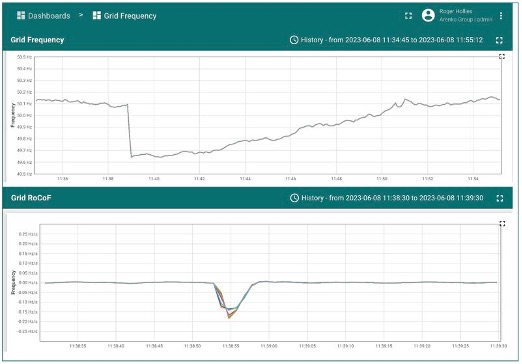
In the UK, there was a huge frequency event (49.63Hz) on Thursday 8th June 11:38 caused by a loss of power to the grid slowing the speed of the grid down like the engine of a car hitting a steep hill.
Industry data points towards a 1.4GW instant loss of power from the North Sea Link interconnector. Demand was just shy of 31GW so this was an instantaneous loss of nearly a 5% of generation.
The National Grid ESO D* frequency response services came into play and batteries across the country responded provide power to stabilise the system. 6 of the 14 grid scale batteries controlled by the Arenko Group platform were participating in DC markets and so responded within 250ms of the frequency deviation had a total response of 137MW delivered with microsecond and kW accuracy in proportion to the frequency deviation. These actions by Arenko and others delivering these services to the market service terms are vital to supporting a net zero carbon future.
The graphs from our platform shows 20 mins of frequency data over the event and 20 seconds of ROCOF (rate of change of frequency). It is worth noting that these graph show data from 19 measurement points on batteries controlled by the Nimbus Asset software showing how instantaneous these impacts are from Scotland to the South.
Interesting note on inertia: Our data indicates a peak ROCOF of 175mHz/s in this instance this converts to a system inertia of 210GVAs. The ESO data portal gives a modelled inertia of 170GVAs after balancing actions for the period. The ESO target inertia is 140 GVAs. If the system was operating at target with 20-30% less inertia on the grid this frequency deviation would’ve been far higher and potentially pushed the system beyond recovery. It’s a problem.
There are only 3 solutions to this available to the control room today. Reduce the single loss of load:
1) Reduce the impact of a single loss of load: Import less from interconnectors so if there is a problem we lose less power (high cost as interconnectors provide energy at market value)
2) Bring on more fossil fuel generation to provide more inertia (high cost and high carbon impact as these generators will have to displace renewable generation)
or
3) Contract more DC to provide better control in the event of a frequency deviation (low cost and negligible carbon impact).
So there is only one real option and Arenko is part of the solution.